
Enterprise Value doesn't collapse overnight.
It leaks quietly inside the organization.
Why most companies do not have a performance problem — but an execution visibility problem.
Enterprise value destruction is rarely a single event.
Most of the time, it is a slow operational erosion happening quietly inside the organization long before the market fully recognizes it.
Value does not usually disappear overnight. It leaks.
Quietly. Systematically. Across processes, decisions, capabilities, coordination, governance, and execution layers that most organizations struggle to fully see in real time.
And by the time financial statements begin reflecting the damage, the underlying organizational deterioration has often been happening for quarters — sometimes years.
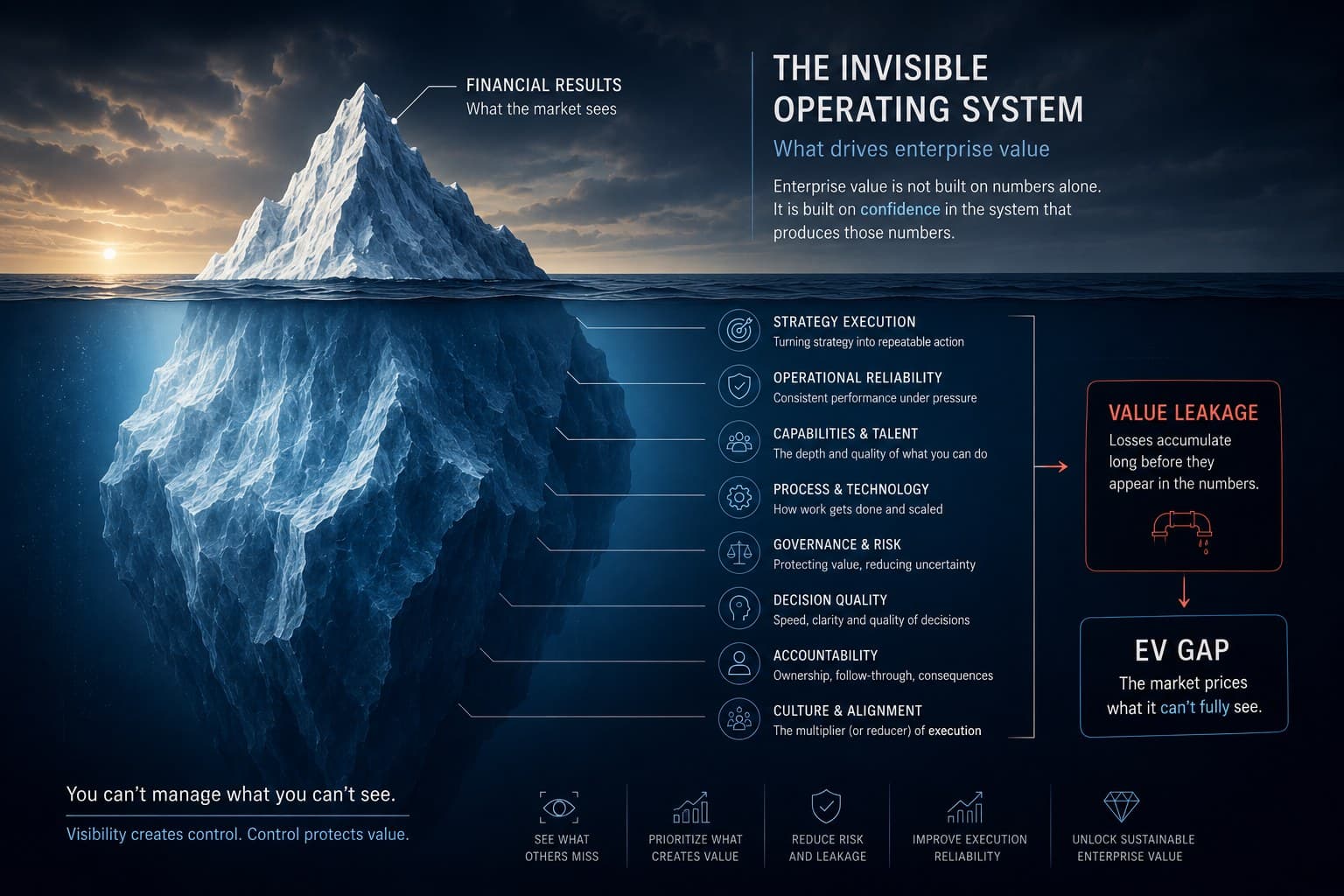
This is one of the most misunderstood realities in business and capital markets.
Because most organizations still evaluate performance primarily through financial outputs:
- Revenue growth
- EBITDA
- Margins
- Earnings per share
- Cash flow
But financial metrics are consequences. They are lagging indicators of an operational system that may already be weakening underneath.
The market sees the numbers. What it struggles to see clearly is the machine producing those numbers.
And in many cases, organizations themselves cannot fully see that machine either.
The invisible erosion inside organizations
Most enterprise value destruction does not begin with a strategic collapse.
It begins with small execution failures accumulating over time:
- Decisions slowing down
- Operational friction increasing
- Accountability becoming diluted
- Leadership alignment weakening
- Processes becoming inconsistent
- Transformation initiatives losing momentum
- Technical capability gaps expanding
- Governance becoming reactive instead of preventive
Individually, these issues often appear manageable. Collectively, they create organizational fragility. And fragility compounds silently.
At first, the company may still appear healthy. Revenue may continue growing. Margins may remain stable. Guidance may still be achieved.
But internally, the reliability of execution starts deteriorating. This is where value leakage begins.
Not necessarily because the strategy was wrong. But because the organization gradually lost the ability to execute consistently under pressure.
Financial performance alone does not explain Enterprise Value
Two companies can generate similar financial results and still trade at dramatically different valuation multiples.
Why?
Markets do not price performance alone. Markets price confidence.
Confidence in:
- Execution reliability
- Operational resilience
- Leadership credibility
- Governance quality
- Scalability
- Predictability
- Adaptability under uncertainty
- Organizational discipline
- Risk management capability
Enterprise value is not built only on numbers. It is built on confidence in the system that produces those numbers. And that system is organizational.
This is one of the reasons enterprise value gaps exist even among companies operating in the same industry with comparable financial performance.
The market is constantly attempting to answer a deeper question:
How reliable is this organization's ability to sustain execution in the future?
Most traditional performance systems are not designed to answer that question.
The visibility problem
The challenge is not simply execution. The challenge is visibility.
Most organizations cannot clearly see:
- Where execution is weakening
- Where capability is insufficient
- Where efficiency is creating hidden operational risk
- Where governance fragility is emerging
- Where transformation momentum is breaking down
- Where organizational complexity is reducing scalability
- Where enterprise value is quietly leaking
As a result, decisions are frequently made based on incomplete organizational reality.
Leadership teams often discover operational fragility only after it begins impacting:
- Margins
- Delivery performance
- Capital efficiency
- Growth quality
- Investor confidence
- Valuation multiples
By then, value destruction is no longer invisible. It becomes financial.
The market sees outcomes. But value is created inside systems.
Modern organizations are extraordinarily complex systems. Enterprise value is not generated by isolated functions. It emerges from the interaction between:
- Strategy
- Talent
- Capability
- Execution
- Efficiency
- Governance
- Operational coordination
- Market confidence
When these systems are aligned, organizations create scalability, resilience, and compounding value creation.
When they become fragmented, enterprise value erosion accelerates — often before traditional metrics detect it.
This creates a dangerous gap between:
- Reported performance
- Actual organizational health
That gap is where execution risk lives. And execution risk is ultimately what markets discount.
The visibility challenge ahead
For decades, organizations focused primarily on measuring financial outputs.
But the next evolution of enterprise performance may depend less on measuring outcomes alone — and more on understanding the quality, resilience, and reliability of the operating system producing those outcomes.
Because enterprise value is not shaped only by financial performance. It is shaped by confidence in an organization's ability to continue executing under pressure, uncertainty, complexity, and scale.
The challenge is that most organizations still lack visibility into that system. And what cannot be clearly seen cannot be consistently protected, improved, or scaled.
The companies that will create disproportionate long-term enterprise value may not necessarily be those with the best short-term financial performance. They may be the ones that develop the deepest visibility into how execution actually happens inside the organization — where value is created, where fragility is emerging, and where enterprise value is quietly leaking long before the market fully recognizes it.
EVE Intelligence
EVE Intelligence publishes field notes and methodology papers from the work of helping organizations make execution visible — and translate it into enterprise value.